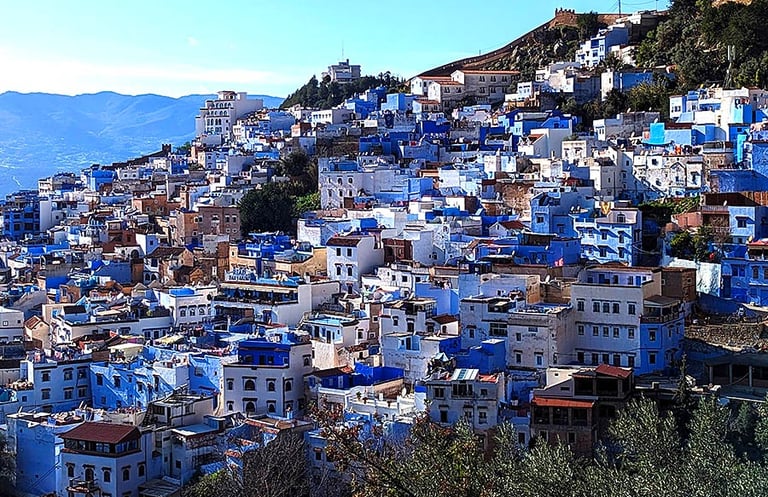


Fez The Holy City of Fez is a jewel of Spanish-Arabic civilisation. Fez does not reveal its secrets easily. Secretive, shadowy, they need to be discovered little by little, with reverence.

Only in this way can the splendours of Medersa architecture be fully appreciated. Only in this way will the call of the medina temt you. Bustling with artisans and merchants, its captivating sounds, fragrances and colours mesmerise the visitor with a constant swirl of activity.


Only in this way can the splendours of Medersa architecture be fully appreciated. Only in this way will the call of the medina temt you. Bustling with artisans and merchants, its captivating sounds, fragrances and colours mesmerise the visitor with a constant swirl of activity.


I m p e r i a l   C i t i e s

The city of Moulay Idriss lst, sanctuary of human and moral sciences. The great Àl Karaouiyne University has for eleven centuries been a religions and intellectuel centre whose influence has spread far beyond the Kingdom's boundaries. In 789, a pick-axe of silver and gold -"fas" in Arabic - was presented to Idriss lst to use in tracing the outlines of the city. Hence the name of the city, which lies at the far eastern end of the plain of Saïss, bordered to the south by the hills outlying the Atlas Mountains. Cradle of religions, cultural and artistic traditions, Fes, the double city, is the kingdom's spiritual capital.


The Andalousian mosque, dating from the 9th century, and further embellished by successive rulers, is accessed through a mighty door of sculpted cedar. An imposing minaret decorated with green faiences crowns the Rsif Mosque. The medersas around the Karaouiyne Mosque, former lodging houses for students coming from outside the city, attest the importance of its thousand years of history.

In the Medina, a labyrinth of sloping, winding alleyways are crammed full of stalls and workshops. This is the famed Kissaria -the commercial centre. A multitude of locally produced goods are on sale in this incredible maze-cotton fabric, silk, brocadework, slippers, and many more.

The craftsmen of the El Atterine souk offer the visitor a non-stop spectacle. For hundreds of years such work bas been regulated by traditional guilds, ensuring that its quality is worthy of the city. Each district has its own speciality : cobalt blue enamelled pottery, carpets, wrought iron ... one looks on as the dyer stirs his yarns, steeped in their multitude of colours, as the tanner tramples his skins under an open sky -skins that the leather-worker will eventually adorn with fine gilt for book-binding.


sites to visit:


Bab Boujloud
Leaving the souks through the Boujeloud gate with its décoration of green and blue faiences, the riches contained in the wonderful Museum of Moroccan Art await one. And the last marvel of all -the Jamaî Palace, transformed in 1930 into a luxury hotel, an incomparably elegant structure renowned for the quality of its cuisine.

 
Medina Fez El Bali : This is Morocco's oldest and most interesting old town. It was declared a world cultural site by UNESCO in 1976. Its narrow, twisting streets lead the casual stroller to a myriad of historical marvels and suks (markets).

El Attarine : This is the spice market. Without doubt it is the most colorful one in Fez.

Nejjarine : This little square got its name from the furniture makers who work in the shops located in this district. A lovely fountain covered with tiles and a fronton of sculpted wood finely decorates the attractive little square. It is here that one finds an old Funduk (or guest house), today a museum exhibiting many marvels testifying to the history of woodworking in Morocco.

El Henna : This is a small isolated square planted with trees where one can find all sorts of products and objects of natural beauty including henna.

Seffarine : This lovely shaded square is where the sound of the coppersmiths hammering out the metals resounds from shop to shop.

Debbaghine : Near Seffarine square, the smells lead you to the tanner's quarter where the gifted artisans accomplish their very special work.

Quarouiyen Mosque : Founded in 862 by a Muslim lady, Fatima El Fihria, who came from Quairouan. This is the oldest university in the Arab Islamic world. Fourteen doors give access to the inside of the university which has a priceless library containing over 30.000 volumes.

Moulay Idriss Zaouia : This edifice houses the tomb of Moulay Idriss II, the founder of Fez. This is the top holy site in the city.

M'dersa Bou Inania : An Islamic university built between 1350 and 1357 by Merinid Sultan Abou Inane the architecture of which is one of the masterpieces of Moorish art.

M'dersa Attarine : This is a Koran school built in 1923 by the Merinid Sultan Abou Said which boasts extremely beautiful decoration.

Dar El Magana : This is the hydraulic clock that dates from 1357 located at Talaa Sghira placed in an environment of sculpted plaster and wood.

Dar Batha : Built in 1894-1909 by sultan Moulay El Hassan and transformed into a museum of arts and traditions of Fez and its region.

Borj Sud : This is a fortress built under the reign of Saadian Sultan Ahmed El Mansour Dehbi (1578-1609). Today it houses a light armaments museum. From the Borj one can take in the splendid view looking over Fez El Bali.

Borj Nord : More recent than the one to the South. Today it houses an armaments museum exhibiting firearms and cutting and thrusting arms dating from prehistorical times to the present. This museum is also a great place to take in the wonderful view over the city.

Bab Boujloud : Even though built relatively recently in 1913, this place still remains a genuine architectural marvel.

Fès El Jedid : A palatial group of building situated just to the North of the city and built by the Merinids in the 18th century for a residence of the prices of this dynasty. Fez El Jedid includes the palace and royal palace spreading out over more than 70 hectares.


Copyright © Moroccography.com  Contact