

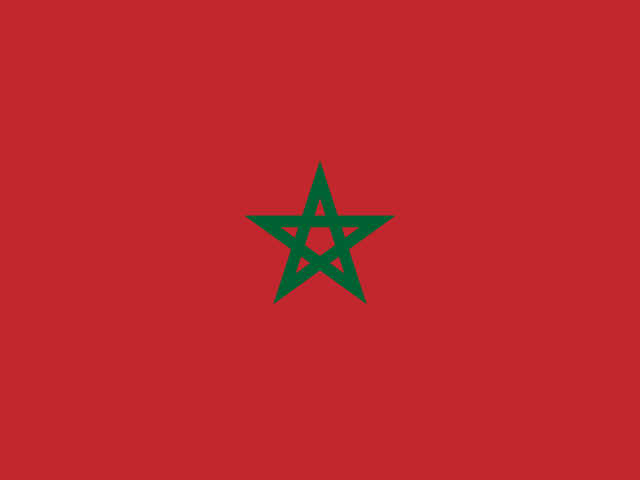
The Kingdom of Morocco occupies an area of 710.850 square kilometres in the north of Africa. The Atlantic Ocean at the western side and the Mediterranean Sea in the north side . To the east and southeast lies the Algerian border and the Moroccan Sahara extends along the south of the country. It is 14 km from southern Spain.

Regime

Constitutional monarchy under the reign of His Majesty :

the king Mohammed the 6th.

The Religion
Islam - Moroccan Moslems belong to the Malekite creed, one of the four orthodox creeds of Islam. The religion is based upon the Koran book dictated by Allah (God) to the prophet Mohammed - and the Hadith (the Prophet's teachings). The world "Islam" means Submission to Allah.


You become a member of the community of Moslem believers once you utter the profession of testimony of the fact that "There is no God other than Allah, and Mohammed is his prophet".The four obligations imposed on the congregation in addition to theprofession of faith are: prayer, fasting, alms giving and pilgrimage.


Fez - The Holy City of Fez is a jewel of Spanish-Arabic civilisation. Fez does not reveal its... More Marrakesh - The first feeling one has when entering this particular imperial capital is of pure... More Meknes - One of the kingdom's imperial cities, Meknes was founded in the 11th century and... More Rabat - The kingdom's political and administrative capital with a prestigious past Capital of... More
Tangier - At the crossroads of civilisation, where the Mediterranean meets the Tangier... More Casablanca - A business capital of increasing importance, and an international metropolis... More Handicraft - The products of Moroccan handicraft are one of the fundamental... More Jewellery - By itself or combined with emeralds, pearls and Turquoise, gold composes... More


Capitals
National capital : Rabat
Economic capital : Casablanca
Touristic capital : Agadir


Population

29 891 708 (in 2004)
The Berber were the original people of Morocco and the majority of modern day Moroccans are pure Berber. Arabs came to Morocco during the Muslim conquests in the 7th century A.D. There is a small minority of black African descent and a European community, predominately French, of about 100,000.


Currency
Moroccan Dirham. 10 Dirhams is about 1 US Dollar or 1 Euro.

Total Land Area
710.850 Square kilometres.

Coastline
2.900 km Atlantic coast - 500 km Mediterranean coast.

Climate
The climate varies according to the regions, the coast has a very mild climate in the summer and humid in the winter, average temperature from 16°C to 26 °C. Inland is much more warmer during the summer up to 33°C.

Transportation
Morocco has 1.893 km of Railway network and 59.474 km of Highways and paved roads. It has Airports in the cities of Agadir, Al Hociema, Casablanca, Dakhla, Essaouira, Fes, Laâyoune, Marrakech, Nador, Ouarzazate, Oujda, Rabat-Salé, Tangier and Tetouan.

Driving

On the right side.

Entry requirements
Passport. (Check passport validity and visa requirement for some countries).

Gastronomy
Moroccan cuisine is reputed to be one of the top cuisine all over the world: Couscous, Mechoui, Pastilla, Tagines, pastries and the national drink, mint tea.

Electricity
220 volts in new buildings
110 volts in older structures
2 pin round plugs are the norm.


Banking hours
8.00 AM to 4.00 PM (Monday to Friday)
9.00 AM to 15.00 PM (during Ramadan).
Change office can be found in airports and most hotels.


International dialing code : From outside Morocco : 212

Time zone : G.M.T.

Fauna & Flora
Morocco has a rich diversity of wildlife including gazelle, wild boar, panther, wild goat, baboon, fox, rabbit, otter, squirrel and horned viper.
The mountainous regions of Morocco contain extensive areas of forest, including large stands of cork oak, evergreen oak, juniper, cedar, fir, and pine.

Natural resources
Morocco is still chiefly an agrarian society but mineral resources, including phosphates, iron, lead, manganese, silver, tin, zinc, coal and petroleum are also mined.


Topography
Morocco has four distinct geographic regions:
The Rif mountains in the north which rise as high as 2,440m (8,000ft), parallel the Mediterranean coast.
The Atlas Mountains extend across the country southwest to northeast between the Atlantic Ocean and the Rif. The highest mountain in North Africa is Jebel Toubkal (4165m/13,665ft), located in the Great Atlas.
An arc of wide coastal plains extend along the country's western seaboard, bounded by the Rif and Atlas Mountain Range. Most Moroccans inhabit this region.
Lowlands south of the Atlas merge with the Sahara along the southeastern borders of the country.
Morocco has many rivers, the chief of which are the Moulouya, which flows into the Mediterranean Sea, and the Sebou, which flows into the Atlantic.


H o l i d a y s


Religious Holidays
There are four Moslem religious holidays:
The Eid el Fitr or Eid Es-Seghir, which closes the month of fasting, Ramadan. The Eid El Adha or Eid El Kebir, the day of the slaughtering of the sheep which commemorates Abraham's sacrifice. The Mouloud, It commemorates the birth of the Prophet Mohammed.
The Ashoura, it originally marked the anniversary of the death of Hocein, grandchild of the Prophet. This holiday has become a sort of merry New year or Mardigras for the children.


National Holidays
"Independence Manifesto" - January, 11
"Throne Day" - July, 30
"National Day" - May, 23
"Youth Day" - August, 21
"Allegiance of Wadi-Eddahab" - August, 14
"Anniversary Of The King And The People" - August, 20
"Anniversary Of The Green March" - November, 6
"Independence Day" - November, 18.


Copyright - Moroccography.com © 2007   Contact