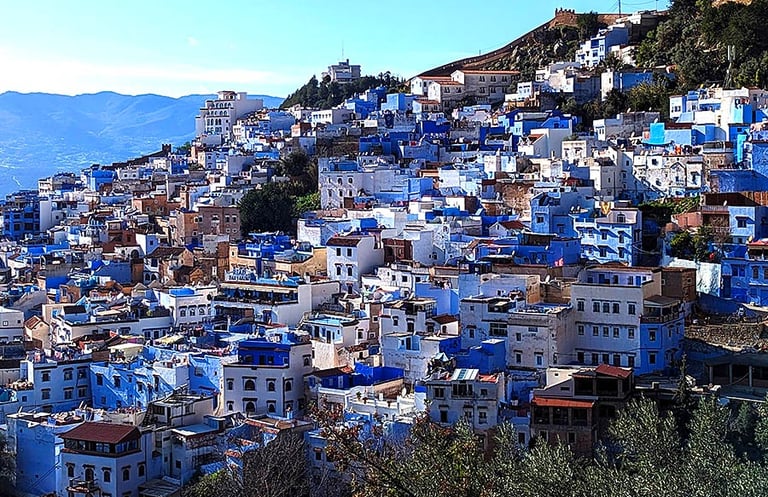


Tangier: At the crossroads of civilization, where the Mediterranean meets the Atlantic Ocean, Tangier flaunts its magnificent bay below lush green hills. From the "Place de la Kasbah", the highest point in the medina, you can visit the sultan's palace where every aspect of Moroccan art can be seen in the rooms round the courtyard.


Or you can stroll down alleyways of the medina to the terrace overlooking the straits of Gibraltar.


Close by, various excursions can be made including Cape Spartel -the extreme north- westerly point of Africa, close to the famous Caves of Hercules and Cape Malabata.


 Its strategic position making it a crossroads of the civilizations, Tangier, gateway to the African continent, looks across at Europe from the shores of Atlantic and Mediterranean alike. As a meeting-point of routes to so many different destination, Tangier has inevitably been marked by the of History-Phoenicians, Berbers, Portuguese and Spaniards had all left their indelible mark on the city before it passed into Moroccan hands.


As do most of the Kingdoms towns, Tangier, the White City, possesses its Medina, the old Arab town containing a pair of picturesque markets : the Grand Socco and the Petit Socco (the Spanish word for "souk").


And apart from the well-known journalist Joseph Kessel, who in 1952 devoted a remarkable book "To the Grand Socco", a whole host of other great names from the world of the arts have been captivated by the sights and sounds of the city on the Straits. Many have spent long periods there, some have even made it their home. The rattle and hum of the Grand Socco has entranced all who watched" .. from morning to evening, the vendors, the customers and the plain curious milling around in sun and wind among the hundred colors of canopy and thousand tongues at work..."

Tangier is also renowned for the Mendoubia gardens, with their eight-hundred-year-old trees, the Sidi Bouabid Mosque, its minaret decorated with multi-hued faiences dominating the Medina, the Kasbah Square with its portico of white marble columns, and the great Mechouar where the pashas were once wont to give audience. The status of international free zone which the city enjoyed for a number of years added to Tangier's celebrity, and it has become an obligatory stop-off for any tourist in search of the real Morocco.

Sites to visit:

The Kasbah:
District of ancient palaces, the Kasbah looks out from the heights dominating the harbor and city.


The Mechouar:
Main square of the Kasbah dating from the 17th century under the reign of Moulay Ismail.

Dar El Makhzen: Rebuilt in 1740 this palace today has become the Museum of Moroccan Arts of Tangier. It boasts a wonderfully representative collection of handicrafts from all over Morocco.

Forbes Museum: This museum is located in a part the former dwelling of American billionaire Malcolm Forbes who bequeathed it to the City of Tangier 1990 shortly before his death. This museum has a collection of 115 000 military miniatures depicting the greatest battles in history (Waterloo 1815, the battle of the 3 kings, the armies of Sultan Abdel Malek...).

Hafa Café: This café has been in operation since the 1920s. It is utterly unique because of the site where it stands. It is nestled against a cliff and includes several small terraces. A lovely world unto itself steeped in inviting shade, amidst beds of flowers, the casual traveler inevitably feels the urge to step in and relax. Among countless others, the Beatles, Randy Weston and Sean Connery all visited here to sip delicious mint tea.

Cervantes Theater: Inaugurated in 1913, this theater was for a time the largest in North Africa. Its extraordinary architecture, the 1400 seats, and its technical installations, among the most up-to-date of the times, were perfect for welcoming the very greatest artists, for instance Lola Flores.

The Grand Socco: Located at the entrance to the old town (medina), the Grand Socco is the most bustling part of the whole town. It encloses the old residence of the Mendoub (representative of the Sultan). The Embassy of Germany also chose this site to install its diplomatic services in the 1940s. Today the building has been turned into a courthouse sporting a magnificent garden. Centuries old trees bear witness to the historical importance of this location.

The petit Socco: This area constitutes the core of the town dotted with small cafés and old hotels. It also boasts an old mosque built in the 18th century on top of the ruins of an old Portuguese cathedral.

Saint Andrew's church: In the 1880s a drive was organized for the construction of this church which was needed by the British who had begun to come to live in Tangier. Sultan Moulay Hassan I made his own contribution by donating the land. In 1884 the bell tower was erected and the arch bears an engraved prayer in Arabic so highly significant of this church's particular character.

The United State Legation : This building was the very first purchase made by the United States government abroad further to Morocco's being the first country to recognize the independence of the new nation. Up to 1923 it was called "consulate" after which it was given the name of legation. Today it exhibits many works of great painters and ancient geographical maps including that of Leon the African.

The New Town: The main passageway of the new town is the Boulevard Pasteur with bright modern buildings running along each side. At one point there is an open site with a magnificent view looking out over the harbor and bay of Tangier. This site is called "Sour Al Maagazine" or "wall of the lazy."

Jbel EL Kebir: This is the residential quarter of Tangier where one can admire the magnificent homes and sumptuous palaces situated under the shade of the forest.


Copyright © Moroccography.com  Contact